
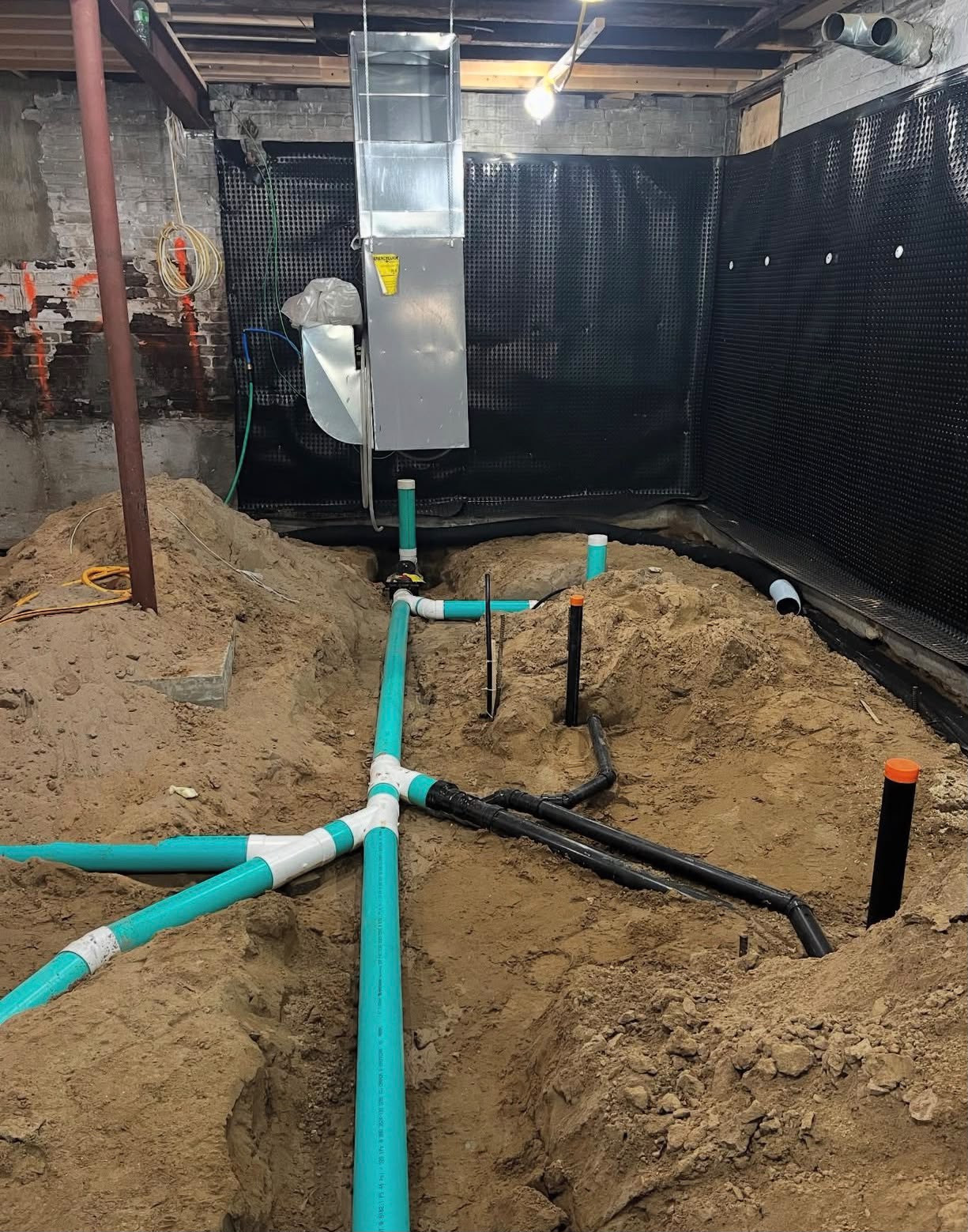
Signs You Need Drain Repair
- Multiple fixtures on the same line drain slowly together
- Gurgling is heard from one fixture when another is used
- A drain empties, then slowly rises again over the following days
- Water backs up into a floor drain or basement fixture
- Sewer-like odours are noticeable near a drain even when it's not in use
- A drain that was recently cleared clogs again within a short period
Pipe materials found across North York
Homes built from the 1950s through the 1970s in areas like Bathurst Manor and Downsview commonly still have cast-iron drain branches, which can develop internal scale and rust buildup over the decades that narrows the effective diameter of the pipe even before anything actually clogs it. Some of the oldest properties also have segments of clay piping in the lower drainage runs, which is more prone to joint separation and root intrusion where it runs underground.
Newer construction and many Willowdale rebuilds use PVC or ABS branch piping, which resists scale buildup far better, though these systems can still develop clogs from grease, wipes, or debris the same as any drain.
Reading the pattern of a backup
When only one fixture is affected, the problem is almost always local to that fixture's own trap or short branch. When multiple fixtures on the same floor or the same vertical stack back up together, the shared branch line further downstream is the more likely location, and that changes both the tools and the access point we plan to use.
A drain that clears temporarily but returns within days often indicates a partial obstruction, such as a grease buildup or a section of scaled cast iron, rather than a single solid blockage, since a full snake typically breaks through the visible clog but doesn't remove the surrounding material narrowing the pipe.
Clearing and repair methods
Most active clogs are cleared with a drain snake or auger sized to the branch line diameter, fed through a cleanout where one exists or through the fixture drain itself when it doesn't. Where scale buildup in cast iron is contributing to recurring slow drainage rather than a single clog, mechanical cleaning addresses the immediate blockage, but the underlying pipe condition is a separate, longer-term consideration worth discussing.
Where a branch line joint has failed, whether from corrosion in old cast iron or a separated clay joint, clearing the line only provides temporary relief and the damaged section itself needs to be addressed directly.
Winter conditions and drain behaviour
Cold weather changes how some drain problems present, since a floor drain or laundry standpipe in an unheated basement or garage area can be more prone to slow drainage when a trap's water seal is affected by temperature swings, and homeowners sometimes notice a backup pattern shift with the seasons without an obvious cause. Ground movement from freeze-thaw cycles can also aggravate an already marginal joint in an older branch line running near an exterior wall or under a cold garage slab.
We take note of when a recurring drain issue tends to show up, since a backup that consistently worsens in winter points us toward checking trap seals and any branch line sections exposed to colder conditions, rather than assuming the cause is purely a buildup of debris.
A floor drain that's rarely used, such as one near a laundry area or utility room, can also lose its trap seal simply through evaporation over weeks or months without any fixture use, letting sewer gas odour into the space even though the line itself isn't obstructed. Pouring a small amount of water down an infrequently used floor drain periodically keeps that trap seal intact.
How We Handle It
- 1
Map which fixtures are affected
We determine whether the backup is isolated or shared across multiple fixtures to locate the likely branch involved.
- 2
Locate a cleanout or access point
An existing cleanout is used where available to avoid working through a fixture drain unnecessarily.
- 3
Auger or snake the branch line
The line is cleared with a tool sized appropriately for the pipe diameter and material.
- 4
Test multiple fixtures on the line
We run water through each connected fixture to confirm the shared branch is flowing freely.
- 5
Note any material or joint concerns
Where cast-iron scale or a joint issue is observed, we point it out as a separate consideration from the immediate clearing.
Why Choose North York Plumbing
We keep the conversation direct, connect the recommendation to what we can observe and take care around the surrounding property. Our 24/7 line is available for urgent situations, while planned work can begin with a detailed request.
Read our reviews on GoogleFrequently Asked Questions
How do you know if the problem is one fixture or a shared branch line?
We check whether running or draining one fixture causes another connected fixture to gurgle or back up. If the effect is isolated, it's local; if it spreads across fixtures, the shared branch line further downstream is the more likely cause.
Why does a drain that was just cleared clog again quickly?
That pattern often points to a partial obstruction like grease or scale buildup along the pipe walls rather than one blockage, since clearing removes what's directly in the path but not necessarily the surrounding buildup.
Are cast-iron drains in older North York homes a bigger concern than newer PVC?
Cast iron can develop internal scale and corrosion over many decades that narrows the pipe and roughens its interior, making buildup more likely compared to PVC, which has a smoother interior surface. Both can still clog from debris, but the underlying pipe condition differs.
Do you need a cleanout to clear a branch drain line?
A cleanout makes access more direct, but where one isn't present or accessible, the line can often still be cleared through the fixture drain itself using an appropriately sized tool.